metal, slag, ceramics | archaeometallurgy
Jan 20 2026

Bloomery Steel of the Early Iron Age from Iberia. New Article

Bastian Asmus

Background

Early iron metallurgy of the first millennium BCE is often described either as technically immature or as a sharp break from Bronze Age practice. Both views are too coarse. Our new study of a bloomery steel chisel from Rocha do Vigio shows a more gradual development (Asmus et al 2026).
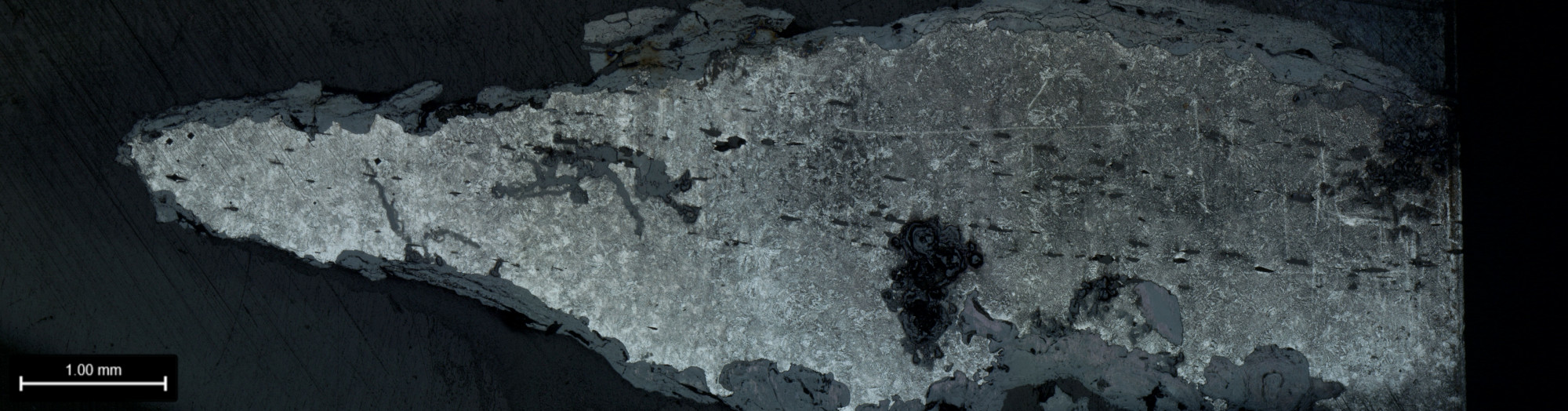
A composite mesoscopic image of the bloomery steel chisel-tip. © 2025 Bastian Asmus

A composite mesoscopic image of the sampled bloomery steel chisel-tip. © 2025 Bastian Asmus

The artefact

The object was made for a bloomery iron and is dated to the ninth century BCE.  In an earlier study, we characterised the metal as bloomery steel and determined its carbon content. Quantifying carbon in hardened material is only partly reliable. For this reason, the first study focused on the body of the tool. The cutting edge was not examined at that stage (Araque Gonzalez et al 2023).

Based on a carbon content of about 0.5 wt% C and the early date of the artefact, we later investigated the tip itself. The aim was to assess whether, and to what extent, it had been thermally treated of it was  hardened at all.

Bloomery steel: Microstructure and hardness

Metallography of the cutting edge shows a homogeneous and very fine pearlitic to pearlitic-bainitic microstructure. Ferrite is present only in small amounts. Martensite is absent. This points to accelerated cooling, but not to full quenching in the modern sense.
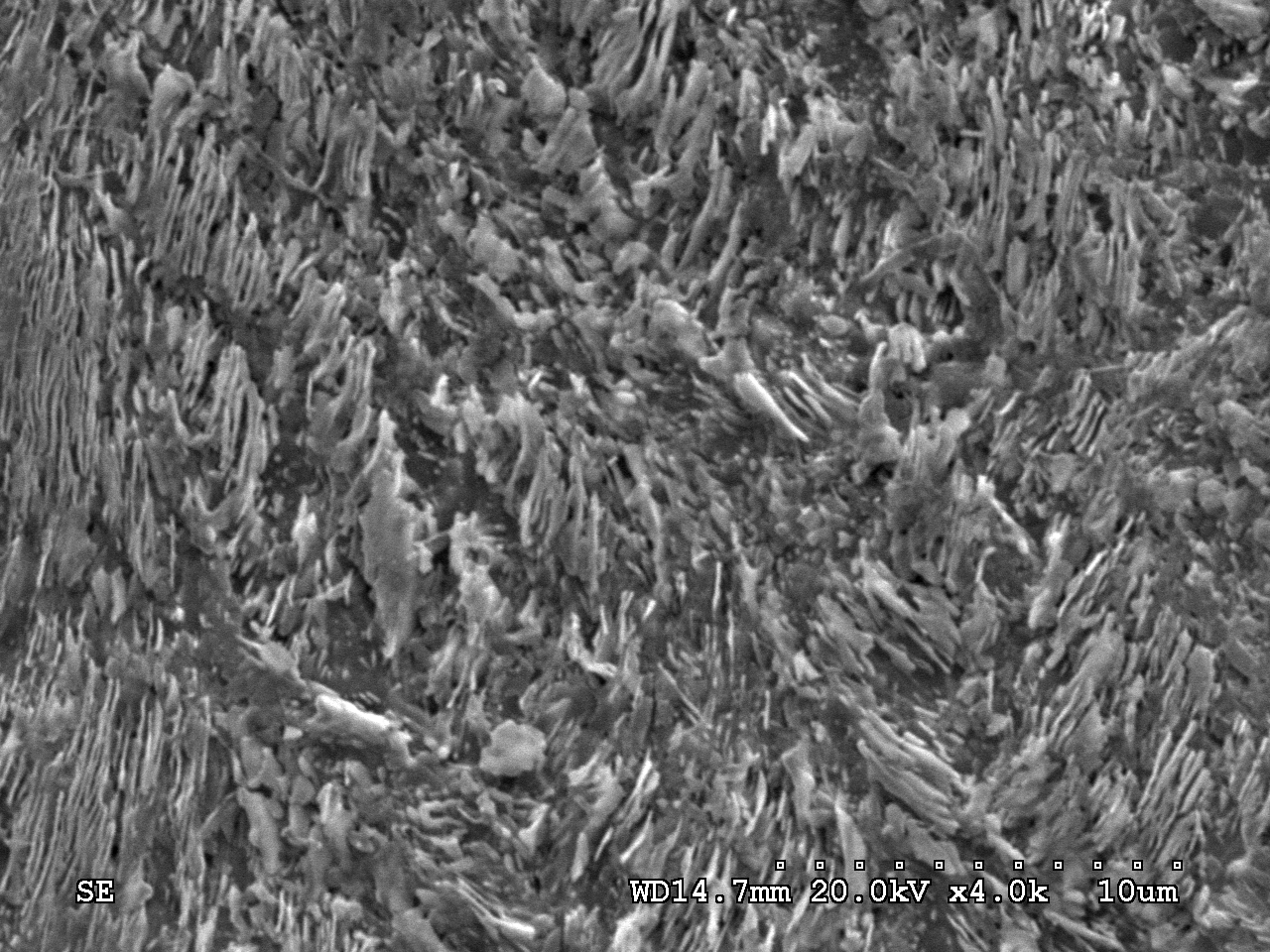
Micrography of the bloomery steel sample from Rocha do Vigio, Portugal.

Secondary electron image of the chisel tip close to the cutting edge, showing mostly very fine pearlite, with some upper bainite in between the feathery colonies of the fine pearlite. Image: Asmus.

Vickers microhardness measurements show a moderate hardness gradient between the softer body and the refined tip. The values are consistent with controlled thermal treatment during forging. There is no indication that maximum hardness was the goal.

Alloy chemistry

The bloomery steel is low in manganese, as expected for early iron. Its hardenability therefore differs strongly from that of modern steels. Many commonly used transformation models are based on modern reference compositions. Our results show that these models are only of limited use for early iron artefacts. More accurate transformation data for low-Mn systems are – surprisingly – still lacking.

Production context

Slags from the site confirm local primary iron production. The chisel is part of a regional metallurgical practice. It is not an imported or exceptional object.

Taken together, the evidence points to a deliberate transfer of Bronze Age thermal working strategies to iron. Early iron metallurgy in this case reflects continuity of skill rather than a technological breakthrough.

The full article is available here:

https://doi.org/10.1016/j.jmrt.2026.01.091
References

Araque Gonzalez, Ralph, Bastian Asmus, Pedro Baptista, Rui Mataloto, Pablo Paniego Díaz, Vera Rammelkammer, Alexander Richter, Giuseppe Vintrici, and Rafael Ferreiro Mählmann. ‘Stone-Working and the Earliest Steel in Iberia: Scientific Analyses and Experimental Replications of Final Bronze Age Stelae and Tools’. Journal of Archaeological Science 152 (April 2023): 105742. doi:10.1016/j.jas.2023.105742.
 
Asmus, Bastian, Ralph Araque Gonzalez, Rui Mataloto, Marc Gener-Moret, Pablo Paniego-Díaz, and Pedro Baptista. ‘Negotiating between Iron and Bronze Traditions: The Impact of a Tool – The Chisel from Rocha Do Vigio’. Journal of Materials Research and Technology 41 (1 March 2026): 1615–29. doi:10.1016/j.jmrt.2026.01.091.

Dec 6 2024

Medieval bell casting: New Paper!

Bastian Asmus
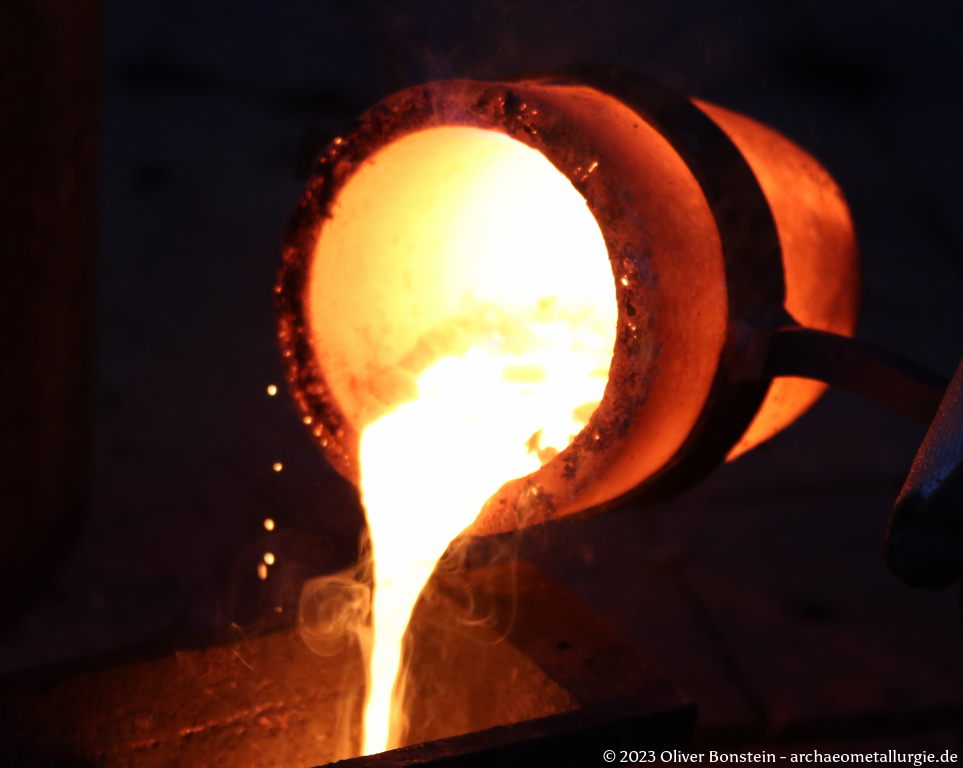
Medieval Bell Casting. Casting of the Bürgli Bell in 2023.
This image was was shot during the “medieval bell casting” event in Gailingen, where the oldest bell of Baden-Württemberg, Germany was found. Photo: Oliver Bonstein.

Just out now: A paper that summarises several years worth of medieval bell casting projects  (Asmus 2023). It is part with my ongoing research focus on the development of metal casting in the medieval period, roughly encompassing the period between AD 800 and 1600.

The paper is open access and can be accessed here.

Abstract

This paper presents key results from experimental work on traditional bronze casting, focusing on early to high medieval bells, roughly between the 8th and 12th century AD . It demonstrates that combining craft, historical sources, and modern science can effectively revive lost technologies. The reconstruction is based on Theophilus Presbyter’s Schedula Diversarum Artium, dated to the early 12th century, whose precise instructions were critical, though several field-scale experiments were required to refine the process.

These experiments are part of broader research into medieval large-scale casting methods in central Europe. The paper argues that more than experimental archaeology or traditional craft is needed to understand and recreate lost technologies. Researchers must invest significant time mastering materials, tools, and techniques to grasp craft processes fully. Brief experimental engagements fail to capture the depth of these traditions. This approach bridges archaeology and hands-on practice, challenging conventions in both traditional craft and mainstream academia.

Literature

Asmus, Bastian. 2023. ‘Bridging the Past and Present by Skill: Exploring Medieval Bell Casting by Experiment’. Historical Metallurgy 54 (2): 85–102. https://doi.org/10.54841/hm.667.

Apr 27 2024

The Reverberatory Furnace and Bronze Casting

Bastian Asmus

 Todays article mostly is on the reverberatory furnace.  However, this is the beginning of a small series of articles that are concerned with casting of larger objects: Cannon, bells and statuary art. Only recently my colleagues and I published an article on the written evidence with regards to the casting of the large bronze statues. Or so we thought; the statues from the Hofkirche in Innsbruck were made from brass  (Mödlinger, Asmus & Ghiara, 2024).

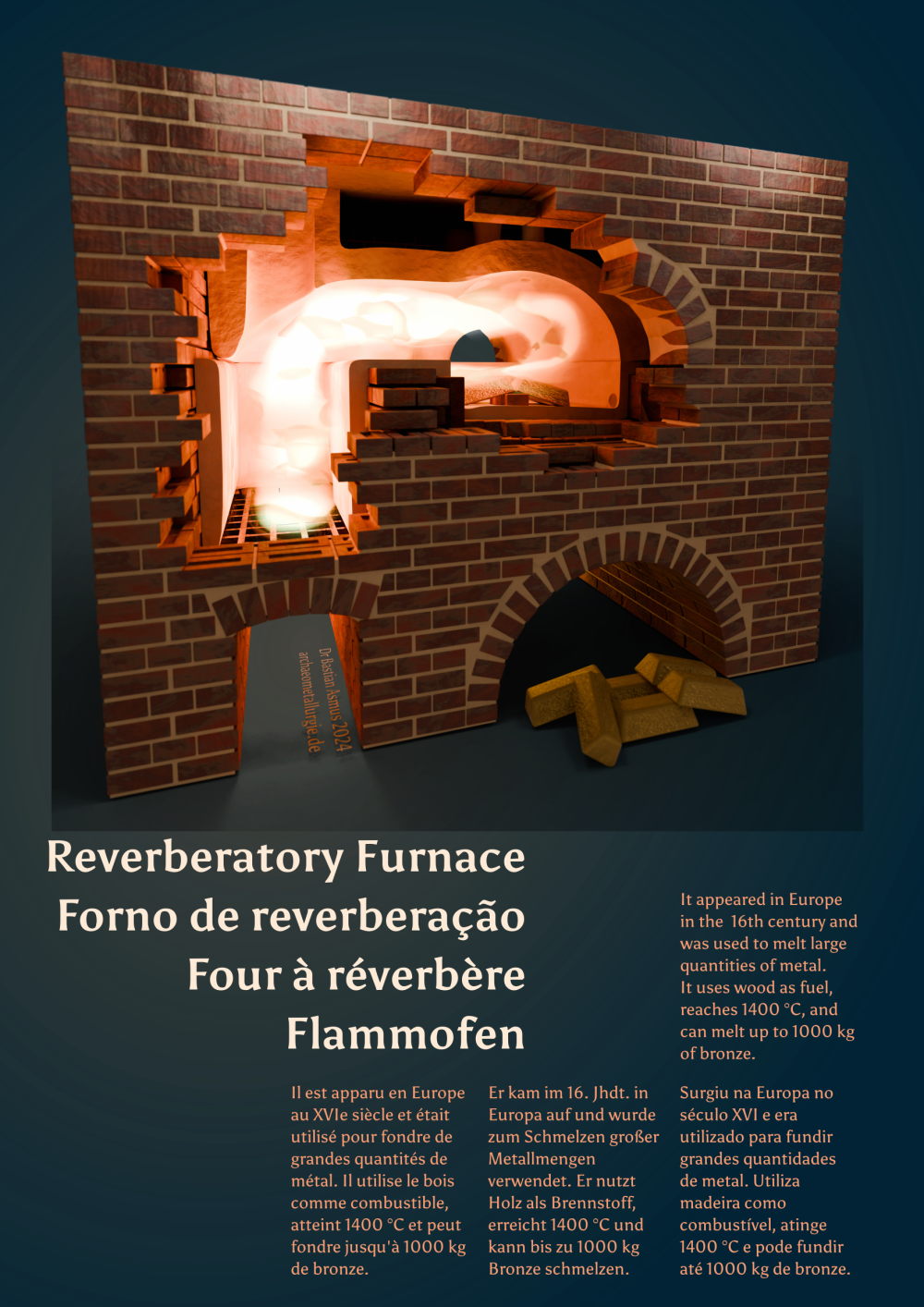
This scheme explains how a reverberatory furnace works. It uses wood as fuel and heats large quantities of metal with the flames only.

A reverberatory furnace hypothesis based on a 16th description (Asmus, in prep)

The beginning of the 16th century is commonly accepted as the end of the middle ages and the beginning of the modern age. This does also apply to the metallurgical trades, because around the same time the reverberatory furnace makes its appearance in Europe. Seemingly out of nowhere, or at least without any apparent predecessors, the reverberatory furnace manifests itself as fully evolved piece of technology in the metal trades. Leonardo da Vinci and Buonaccorso Ghiberti, nephew of the famous Lorenzo Ghiberti left us with sketches of these furnaces. Artists and scholars like Vannoccio Biringuccio (1540) or Benvenuto Cellini (1974, 2005) left us with treatises, where they provide insights into the design and use of these furnaces.

This type of furnace appears more or less suddenly at the beginning of the modern era. There are nor real preceding furnace designs from the middle ages in Europe, so there is a possibility that this concept arrived in Europe as a new concept. The reverberatory furnaces are one key component in the Industrial Revolution (Bulstrode 2023) as puddling furnaces for the making of steel, from scrap iron and also from raw cast iron.

A reverberatory furnace for Vianden

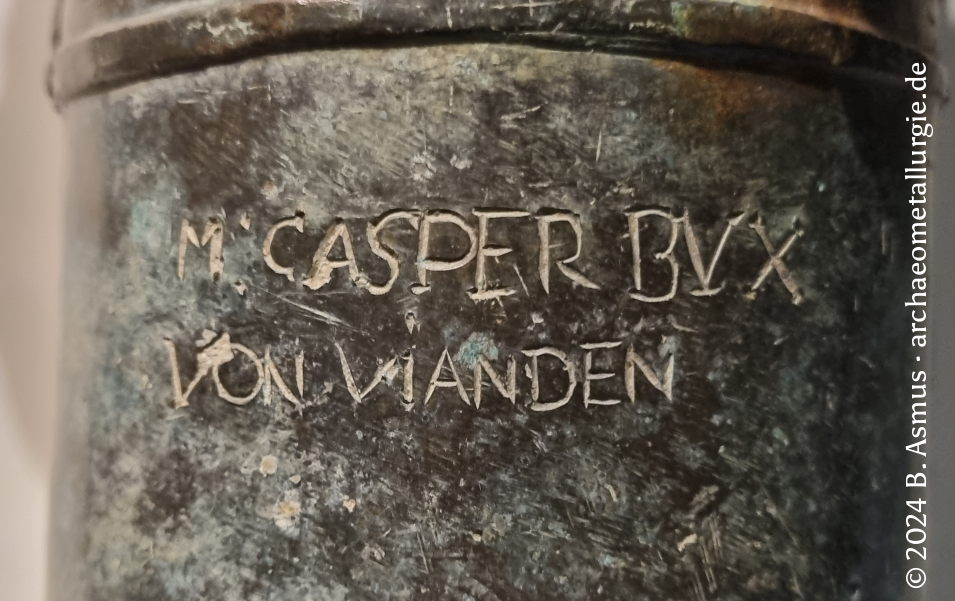
The reverberatory furnace for Vianden is a new reconstruction based on a 16th century treatise of the founding of cannon (Asmus, in prep). The experiment follows the instruction closely and  will  use it to cast a cannon, based on one cannon found at castle Brandenbourg, Luxemburg. It is one of the two cannon made by Casper Bux from Vianden in the 16th century.

An image if the signature of Casper Bux on one the two surviving Bux cannon.

The signature of Casper Bux von Vianden.

The cannon mould will also be made experimentally following a variety of 16th century at the Castle Vianden. The whole process can be seen live at the castle.

A reverberatory furnace not only for cannon

The Vianden  reverberatory furnace is far more than only for cannon casting. With the very same furnace we can cast bells by or the cast of statuary art. As a fully trained bronze caster I do have strong interest also in bronze sculpture, and from the above mentioned Cellini treatise we know that his Perseus with Medusa was made by such with the reverberatory furnace.

To this end I hope that we can use the  Vianden reverberatory many times for the purposes of contributing towards the understanding the intricacies of Renaissance bronze casting and beyond.

References

Asmus, B. (in prep), A techno-critically edition of Kaspar Brunners Report of gun founding.
 
Vanoccio Biringuccio (1540) De la Pirotechnia. Siena. Available at: https://digital.sciencehistory.org/works/n888ils (Accessed: 23 September 2023).
 
Brepohl, E. (ed.) (2005) Benvenuto Cellini. Traktate über die Goldschmiedekunst und die Bildhauerei. Böhlau Verlag.
 
Bulstrode, J. (2023) ‘Black metallurgists and the making of the industrial revolution’, History and Technology, 39(1), pp. 1–41. Available at: https://doi.org/10.1080/07341512.2023.2220991.
 
Benvenuto Cellini (1974) Abhandlungen über die Goldschmiedekunst und die Bildhauerei. Translated by Max Fröhlich. Basel.
 
Mödlinger, M., Asmus, B. and Ghiara, G. (2024) ‘The “Schwarze Mander” of the Court Church in Innsbruck, Austria: Manufacture and Production of Monumental Brass Statues in the Renaissance’, International Journal of Metalcasting [Preprint]. Available at: https://doi.org/10.1007/s40962-024-01299-4.