Archive History | archaeometallurgy
Jan 26 2026

Bronze doors: Medieval Monumental Casting between Technology and Workshop Practice
Bastian Asmus
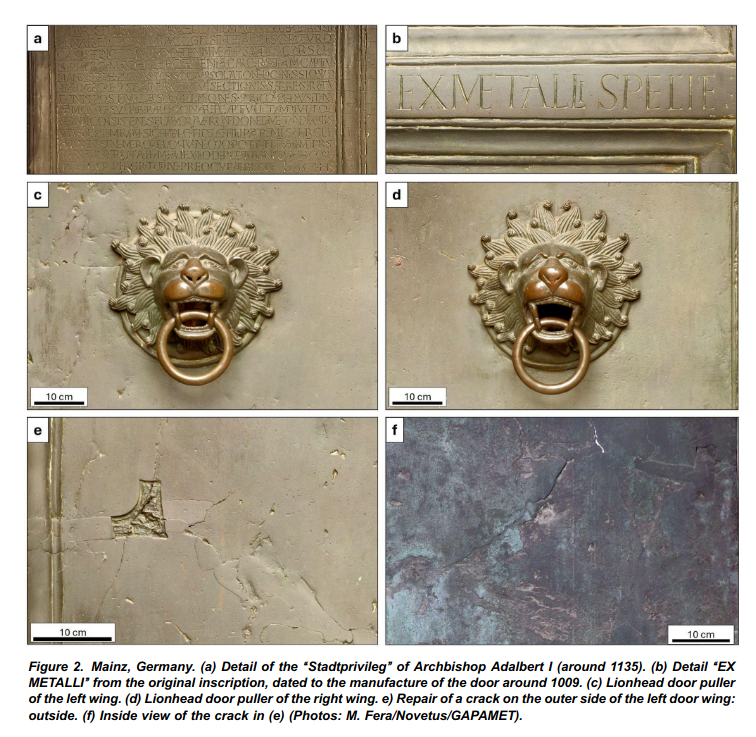
Detailed images of the Mainz bronze doorsP pullers, parts of the inscription as well as of casting fault repairs.

Monumental bronze doors of the High Middle Ages are most often discussed from an art-historical perspective. Their technical dimension has received far less systematic attention. Two closely related studies address this gap by examining the large bronze doors of Hildesheim, Mainz, and Augsburg from a materials-scientific and casting-technical point of view.

The first study takes a comparative approach to all three bronze doors (Mödlinger et al 2026). Based on alloy analyses and casting-related questions, it discusses material choice, casting strategy, and practical feasibility. The results show that the bronze doors are neither technically uniform nor best understood as isolated exceptional works. Instead, each reflects specific decisions, constraints, and priorities within its casting context.

The second study focuses on the Hildesheim bronze doors and places greater emphasis on process-oriented interpretation (Cziegler et al 2025). Casting simulations are used to explore thermal behaviour, solidification sequences, and potential risk zones during the pour. These models do not replace historical evidence. They help distinguish technically plausible scenarios from unlikely ones and allow discussion of possible workshop practices.

Medieval bronze bronze doors: Methodological approach

The methodological approach is central to both studies. The aim is not to describe medieval casting processes as if they were directly observed, nor to project modern metallurgical concepts back onto the Middle Ages. Instead, the focus lies on identifying the technical concepts, experiential knowledge, and problem-solving strategies that could realistically have been available at the time.

The analysis proceeds deliberately from a chronological bottom-up perspective. This is not meant in a hierarchical sense, but as an attempt to understand how casting practice developed through material constraints, process limitations, and workshop routines. The resulting interpretations are therefore necessarily plausible rather than definitive. They are intended to narrow the range of interpretation, not to close it.

Collaboration with Gates of Paradise Project

Both papers were developed in the context of a close collaboration with the GAPAMET project (Gates to Paradise), which focuses on the interdisciplinary study of medieval bronze bronze doors. Over the past two years, our laboratory has worked closely with the team led by Marianne Mödlinger, the project’s principal investigator. This collaboration provided the framework for many of the materials-science and casting-related questions addressed in these studies.

More information on the project:
https://www.gapamet.imareal.sbg.ac.at/en/

A related post from this collaborative context,  led to a separate paper (Asmus et al 2025) on specific workshop practices and means of replicating (wax) models.

Articles

The articles are available here:
https://doi.org/10.1007/s40962-025-01857-4
https://doi.org/10.1007/s40962-025-01820-3
References

Asmus, Bastian, Martin Fera, and Marianne Mödlinger. 2025 ‘Deconstructing Barisanus’ Medieval Casting Technology Based on Digital Twins’. Scientific Reports 15, no. 1 (3 March 2025): 7419. doi:10.1038/s41598-025-91168-9.
 
Cziegler, Andreas, Bastian Asmus, Martin Fera, and Marianne Mödlinger. 2025‘Casting Mediaeval Monumental Bronzes: The 11th Century Door from Hildesheim, Germany’. International Journal of Metalcasting, 27 December 2025. doi:10.1007/s40962-025-01820-3.
 
Mödlinger, Marianne, Bastian Asmus, Martin Fera, Juditz Utz, and Giorgia Ghiara. 2026  ‘Casting Monumental Bronzes in Central Europe in the High Middle Ages: The Doors of Hildesheim, Mainz, and Augsburg’. International Journal of Metalcasting, 25 January 2026. doi:10.1007/s40962-025-01857-4.


Jan 20 2026

Bloomery Steel of the Early Iron Age from Iberia. New Article

Bastian Asmus

Background

Early iron metallurgy of the first millennium BCE is often described either as technically immature or as a sharp break from Bronze Age practice. Both views are too coarse. Our new study of a bloomery steel chisel from Rocha do Vigio shows a more gradual development (Asmus et al 2026).

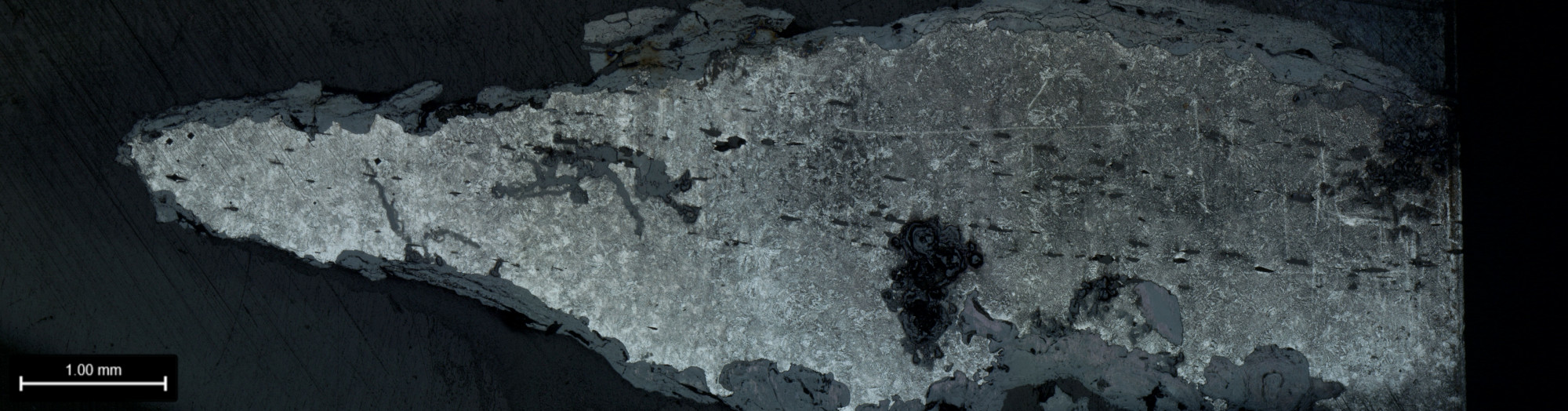
A composite mesoscopic image of the bloomery steel chisel-tip. © 2025 Bastian Asmus

A composite mesoscopic image of the sampled bloomery steel chisel-tip. © 2025 Bastian Asmus

The artefact

The object was made for a bloomery iron and is dated to the ninth century BCE.  In an earlier study, we characterised the metal as bloomery steel and determined its carbon content. Quantifying carbon in hardened material is only partly reliable. For this reason, the first study focused on the body of the tool. The cutting edge was not examined at that stage (Araque Gonzalez et al 2023).

Based on a carbon content of about 0.5 wt% C and the early date of the artefact, we later investigated the tip itself. The aim was to assess whether, and to what extent, it had been thermally treated of it was  hardened at all.

Bloomery steel: Microstructure and hardness

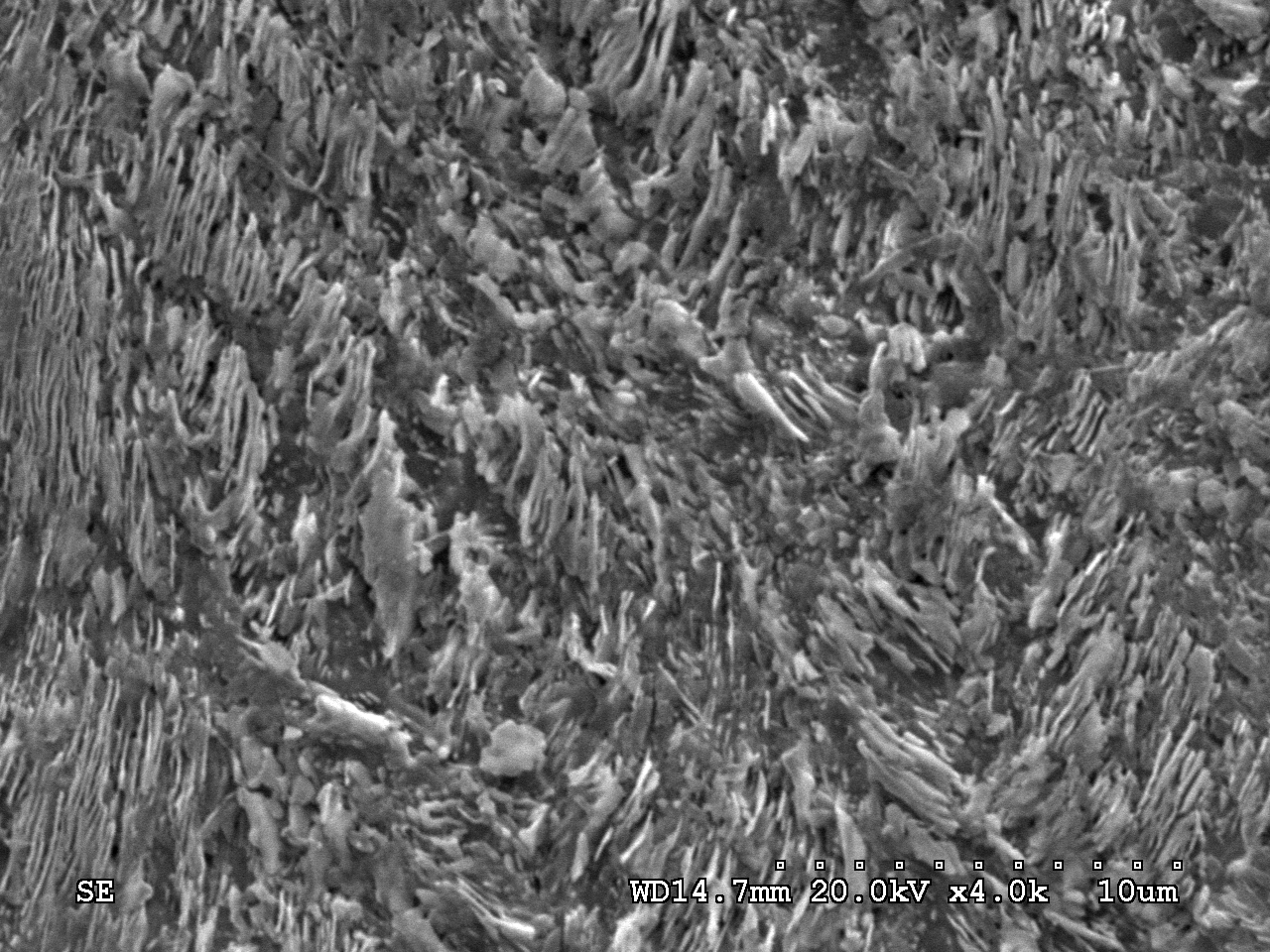
Metallography of the cutting edge shows a homogeneous and very fine pearlitic to pearlitic-bainitic microstructure. Ferrite is present only in small amounts. Martensite is absent. This points to accelerated cooling, but not to full quenching in the modern sense.

Micrography of the bloomery steel sample from Rocha do Vigio, Portugal.

Secondary electron image of the chisel tip close to the cutting edge, showing mostly very fine pearlite, with some upper bainite in between the feathery colonies of the fine pearlite. Image: Asmus.

Vickers microhardness measurements show a moderate hardness gradient between the softer body and the refined tip. The values are consistent with controlled thermal treatment during forging. There is no indication that maximum hardness was the goal.

Alloy chemistry

The bloomery steel is low in manganese, as expected for early iron. Its hardenability therefore differs strongly from that of modern steels. Many commonly used transformation models are based on modern reference compositions. Our results show that these models are only of limited use for early iron artefacts. More accurate transformation data for low-Mn systems are – surprisingly – still lacking.

Production context

Slags from the site confirm local primary iron production. The chisel is part of a regional metallurgical practice. It is not an imported or exceptional object.

Taken together, the evidence points to a deliberate transfer of Bronze Age thermal working strategies to iron. Early iron metallurgy in this case reflects continuity of skill rather than a technological breakthrough.

The full article is available here:

https://doi.org/10.1016/j.jmrt.2026.01.091

References

Araque Gonzalez, Ralph, Bastian Asmus, Pedro Baptista, Rui Mataloto, Pablo Paniego Díaz, Vera Rammelkammer, Alexander Richter, Giuseppe Vintrici, and Rafael Ferreiro Mählmann. ‘Stone-Working and the Earliest Steel in Iberia: Scientific Analyses and Experimental Replications of Final Bronze Age Stelae and Tools’. Journal of Archaeological Science 152 (April 2023): 105742. doi:10.1016/j.jas.2023.105742.
 
Asmus, Bastian, Ralph Araque Gonzalez, Rui Mataloto, Marc Gener-Moret, Pablo Paniego-Díaz, and Pedro Baptista. ‘Negotiating between Iron and Bronze Traditions: The Impact of a Tool – The Chisel from Rocha Do Vigio’. Journal of Materials Research and Technology 41 (1 March 2026): 1615–29. doi:10.1016/j.jmrt.2026.01.091.

Nov 4 2018

Reconstruction of earliest bronze church bell is ringing for the first time

Bastian Asmus

The Carolingian bell is ringing


This reconstruction is unique,

because this bell is not only cast in the shape of the Canino bell, as it has already been done for some decades on different occasions and for scientific investigations. See for this the various excellent works of the colleague Hans Drescher . No, this reconstruction is to be made as a modern original, following the same instructions of Theophilus Presbyter concerning bell making; using the same bell metal and  the same moulding material. In short to do it, as it was supposedly done in the olden days.

This reconstruction in accordance with the production process tries to reconstruct and implement the original production process in such a way that the resulting object does not differ from the original not only in material, shape and form, but also in the way of its production.

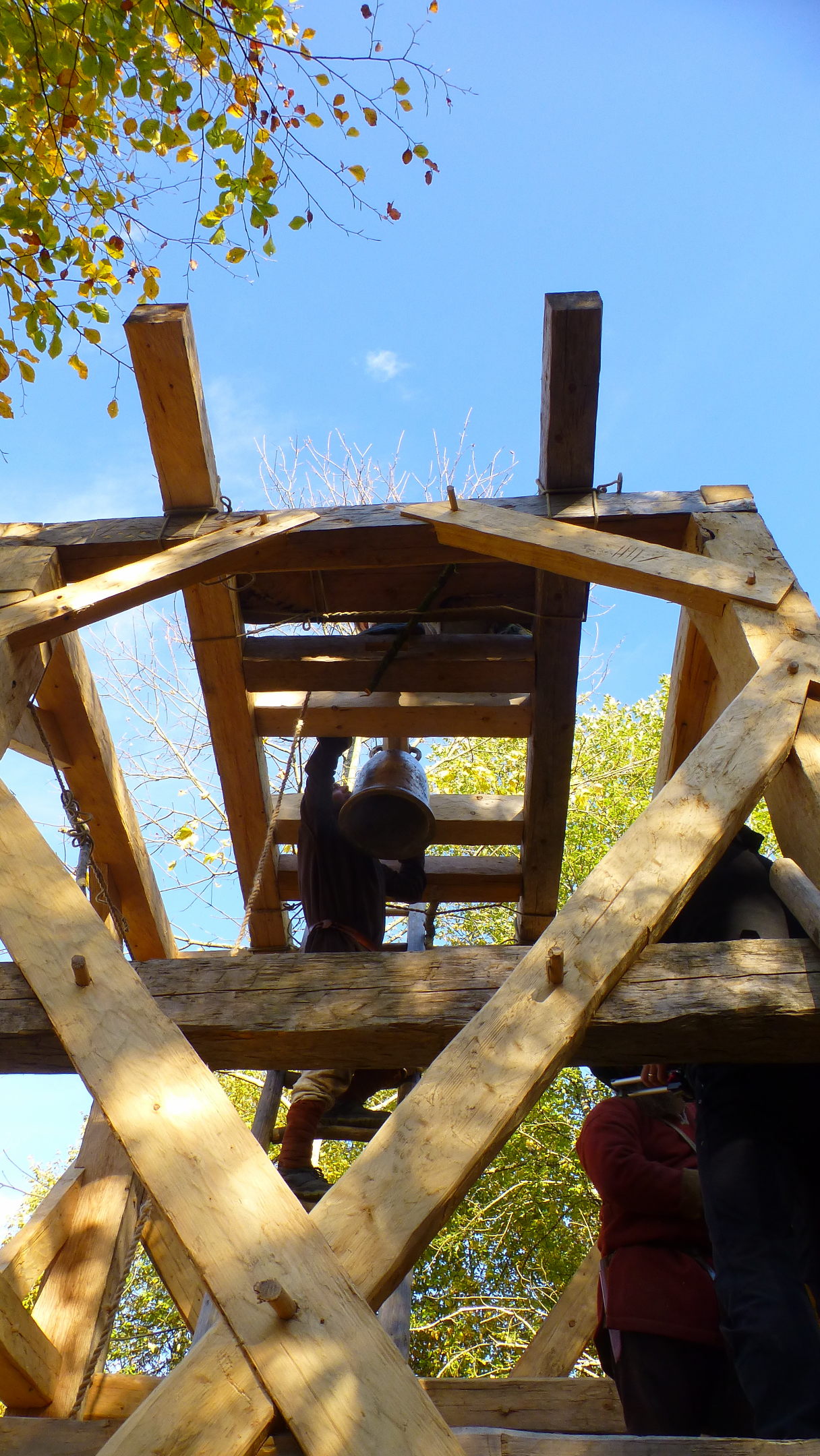
Bell tower for the beehive bell on the Galli campus. Tower, yoke and bell can now be tested for their suitability for the coming years.

Bell tower for the beehive bell on the Galli campus. Tower, yoke and bell can now be tested for their suitability for the coming years.

Applied Archaeometallurgy

As the name suggests, applied archaeometallurgy deals with the applicability of archaeologically, historically and scientifically informed interpretations. The aim is to reconstruct a process that can be applied in practice and that could have been implemented technologically for the epoch in question. It is thus closely related to experimental archaeology. In contrast to this, it additionally formulates the wish for applicability and practicability in the sense of pragmatically acting craftsmen. In addition to the pure functioning of a method, they also have to take care of other aspects such as the production costs, raw material availability, raw material procurement, livelihood and sales of their products.

The Campus Galli Bell, the Tower and the Yoke

The reconstruction of the bell production took place over the last three years and has already been described in numerous articles, e.g. here or here, or here. Beside a specialist publication  the experiments also led to a reconstruction for the Romanesque Bartholomew Chapel in Paderborn, which will be hung there in August 2019.

For the reconstruction, a bell tower and a yoke were designed by the craftsmen of Campus Galli, which can now be tested for their practical suitability over the next few years. Sources  on yokes for early  bells is very thin: Only one yoke of the Haithabu bell is preserved . The description of Theophilus Presbyter needs more interpretation  and  is still waiting for a practical implementation.

In the afternoon of 26.10.2018 the time has come: The bell rings for the first time, and compensates with its sound from the Carolingian period for variuos failed attempts in the past three years.

Literature

{1698736:CKJS5RNK},{1698736:CPX92XCU};{1698736:RJWDMP9E};{1698736:IGMSQH5B} harvard1 default asc 0 3106